


I helped organize the Global Risk and Stabilization Summit in Reykjavík last week, and these are my own views, not ARC’s. To make sure the conversations were truly open and honest, we ran it under the Chatham House Rule, so I’ll avoid attributing anything here to anyone by name.

Several people have already written up their takes on the summit. Joshua Elliott, who directs ARC at Renaissance Philanthropy and convened the summit, wrote his own reflections and links to several of the others, and I’d recommend Susan Su, Noah Deich, Robert Höglund, and Ben Shread-Hewitt for a range of reads on where the field is right now. Between them they cover the politics and the money and the hard questions about how to do research and governance and legitimacy well, which is all fair and well-trodden ground that I’ve written about many times. These are great wide-angle views of the summit, so here I want to share a much narrower view, about one experience I had there that surprised me and changed how I think about all of this.
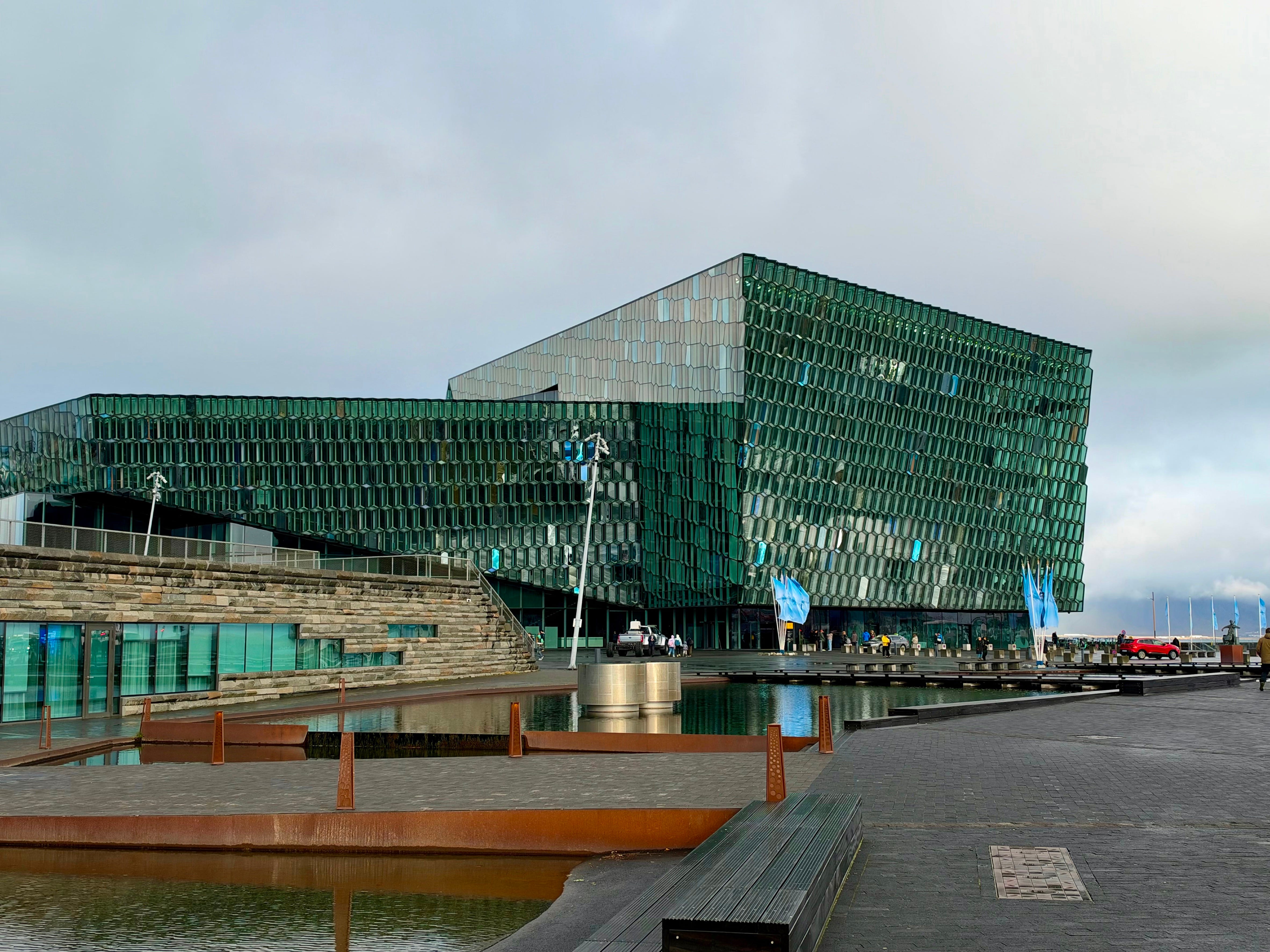
More than 250 people from six continents came to Harpa in Reykjavík for two days of sessions on catastrophic climate risks and what we might do about them, and then a smaller group spent a third day on a backcasting exercise to help figure out what organizations working in the stabilization field should prioritize over the next couple of years to meet longer-term goals. For me it was a chance to spend a few days on the things I care about most, which is understanding what the risks are and what’s driving them, and what we might do to reduce them in the form of potential interventions. The rest of the ARC team and I spent months preparing for this and thinking hard about how to balance the politics of everything and how to pull it off logistically, and I think the team did an incredible job.
One of the things we were going for was getting people who work on very different parts of this into the same room, so that the people researching marine cloud brightening to protect coral reefs were talking with the people designing a seabed curtain for Thwaites Glacier, the people thickening Arctic sea ice, and the people studying stratospheric aerosol injection (SAI). Those might seem like quite different things, but this is a small field, and it would benefit all of us to collaborate more, because we’re often going through the same challenges, whether that’s establishing the legitimacy to do the research, finding funding, working through governance questions, or figuring out how to engineer and scale these things. I heard a lot of conversations about new collaborations and creative projects and new ways of talking about this work. Of course what we were discussing is terrifying, because the risks are huge and real. But people were really interested in digging in and figuring out how they could contribute, and I could feel some camaraderie building. One person who has been working in this field for a long time told me their mind had been expanded, which I took as a huge compliment, because if we could do that for someone who already knows the subject so well, then I think we did our job.
The scenario
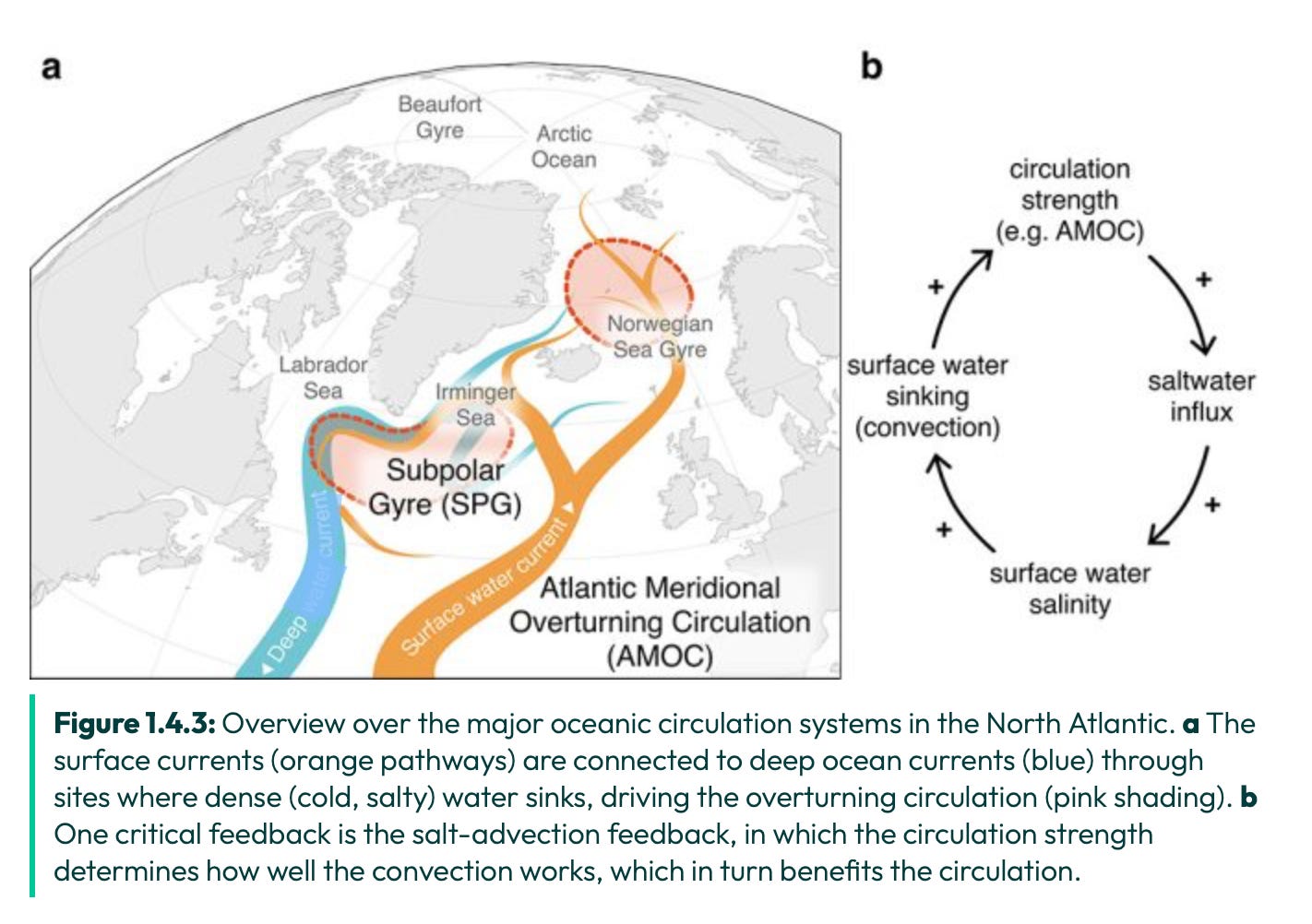
The experience I want to write about came on the second morning, in one of five sessions running at the same time. It included a lightweight scenario exercise, and we were asked to imagine that it’s 2031, Europe is having the coldest winter in living memory, and the subpolar gyre has collapsed. The subpolar gyre is the loop of ocean circulation south of Greenland, and parts of it are where surface water gets cold and dense enough to sink in winter. When that sinking shuts down, it can speed up the weakening of the bigger Atlantic Meridional Overturning Circulation (AMOC), according to the 2025 Global Tipping Points Report. Each table played a government in northern Europe tasked with protecting people and preventing things from getting worse, like a full AMOC collapse (which the briefing said could also bring severe monsoon reductions in South Asia, far from the countries we were playing), and we sorted what we’d do into those two columns, protect and prevent.
I was sitting at a table of people who know this subject very well, and the protect column filled up fast. Even here in 2026, with Russia’s war in Ukraine and the American war on Iran, fuel and energy costs are already high, so we talked about heating fuel subsidies and retrofitting buildings with better insulation, and really just how you keep people warm through the winter. We talked about food systems, whether to start stockpiling food, and whether to subsidize alternative protein development in case global food supplies get hit, and we talked about the energy grid. And if things got worse and sea ice reached the east coast of Britain, which the briefing raised as a possibility if the whole AMOC collapsed, do you start building more icebreakers so you can keep ocean trade going? These are expensive and time-consuming investments and activities.
When it came to prevention, all we could come up with was a rapid deployment of SAI. As I understand it—and this is much debated—what you’d want for AMOC risk is to lower the air temperature and keep as much of Greenland frozen as you can, both of which SAI could plausibly help with. The problem is that by the time the SPG shuts down, it’s almost too late, and it doesn’t really protect you that much, since the ocean is slow to respond (one modeling study found that emergency SAI didn’t bring back the sinking in the North Atlantic, though it partly stabilized the overturning). And it wasn’t just our table. When the room reported back, one table’s main prevention investment was getting ready to deploy SAI, another said interventions would be tempting in an emergency but “won’t help instantly” and focused on insulation and studded winter tires and sand on the streets and public campaigns telling people how to dress warmly, and the rest mostly talked about resilient energy and food supplies and communicating with the public well before a crisis.
What I took from it
My takeaway was that even in a session full of people who had come to a summit to talk about intervention options, we spent most of our time on crisis response, and we didn’t feel like we had much available on the intervention side at all. Everything in the protect column was what I’d call adaptation, and the prevent column, which is where stabilization would go, had almost nothing in it.
The idea of a gyre collapse in 2031, only four or five years from now, is really quite scary. We don’t know that it’s going to happen, and it could be much further away than that, but the 2025 Global Tipping Points Report says the gyre likely has a tipping point around 1.5°C of warming, and we’re already at about 1.4°C and heading into overshoot, which makes it one of the nearest tipping points we know of. I came away thinking, oh shit, this is coming at us really fast, and we’re even more underprepared for it than I thought. And the conclusion I came to is that we need to be thinking much bigger about stabilization, both about the size of the options we’re researching and about the size of the field doing the research, because that’s how big the risks are.
Why we think small
I can imagine how “think bigger” sounds to someone who is new to this field and feeling kind of overwhelmed. We’re already talking about stratospheric aerosol injection and stabilizing ice sheets—things we aren’t capable of doing today—and now I’m saying we need to think bigger? And I know it’s hard to imagine being more prepared in the current geopolitical environment, with so much populism and protest, every country broke, bond markets bad and inflation high, fear of right-wing demagogues taking power, and a retreat from investing in even basic mitigation and the energy transition. I get why people are mostly thinking about what we can eke out right now, and yet I’m still convinced we have to be thinking as big as we possibly can.
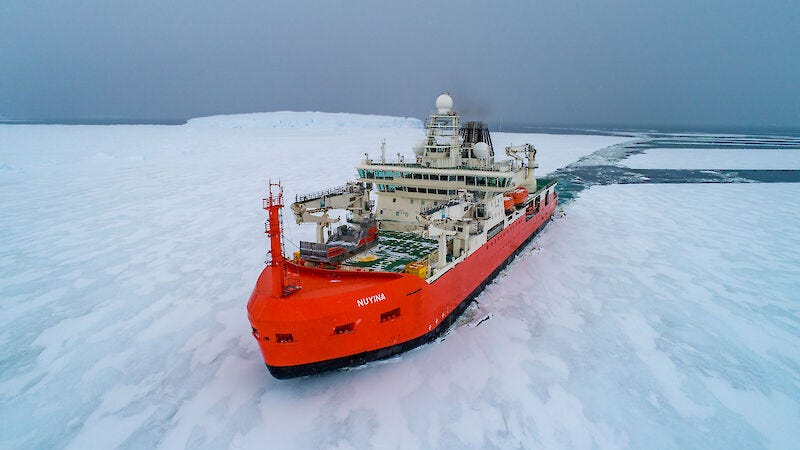
I saw a small version of that tension during the workshop on the third day, when one of the tables was talking about what’s holding the field back and someone said it would be really nice to have a dedicated polar research icebreaker. I asked, “Okay, well, how much does that cost?” and the answer was something like, oh, it’s really expensive, that’s probably not going to happen, which is a pretty natural reaction in a field that’s used to working with very small budgets. But I was curious, so I asked again, “No, really, how much does that cost? We should find out,” because I think we need to be thinking about the art of the possible here. It turns out a research icebreaker like that costs somewhere from $300 million to a billion dollars (Australia’s new Antarctic icebreaker, the Nuyina, cost about A$528 million [$370 million USD] to design and build). That’s a lot of money, and I wouldn’t expect philanthropy to pay for it. But it isn’t impossible. Given the stakes, I think most of us would agree it’s warranted, and if the public funding or a way to finance it were there, it would be a good, smart thing to do.
More than that, the whole spirit of a backcasting exercise is to start from what would make this work well and then work backward from there. If the right thing to ask for or campaign for is a dedicated icebreaker, then we should be talking about that, at least in a workshop designed to get us thinking about the future and what we need to do next.
Thinking bigger
Back in the gyre session, once we’d acknowledged that SAI wasn’t really going to do a lot by 2031, I started asking myself whether we had any actual response options, and it got me curious about adding salt to the North Atlantic, which sounds crazy at first. Greenland is losing about 265 billion tons of ice a year more than snowfall replaces, and that fresh water makes it harder for surface water to sink. Back of the envelope, bringing all of it up to the salinity of seawater would take something like 9 to 10 billion tons of salt a year, roughly 35 times what the whole world produces. But that’s also about the same weight as all the coal humanity digs up in a year, so it’s crazy, but humans could do that.
That’s only a rough sense of scale, since warming is expected to drive more of the AMOC’s weakening than meltwater, so nobody knows the real number yet. Some quick searching while at the summit, and I found out there’s actually a research project on this at the University of Chicago, led by B.B. Cael, an assistant professor of geophysical sciences, and thank goodness, because that’s warranted and it should be investigated, including what it would do to ocean life. The project (with an incredible name: Jump-Salting the AMOC) will look at how much salt it would take, whether smaller additions made earlier could prevent a collapse, how you’d distribute salt at that scale, and how the costs compare with the damage from a shutdown.
So right now, thinking bigger means research and readiness sized to the risks, like a research icebreaker and a serious study of salt, so that we actually know what our options are. Whether to deploy any of it is a decision for governments. What I’d really like to see is for a government facing a 2031 winter to have real options already worked out, so it isn’t stuck choosing between doing nothing and going with whatever somebody happened to have built by then.
The scenario showed me a second problem as well, which is that all of a sudden we were facing all of these immediate new problems that needed money and time and political capital. Even if the prevent options had been worked out, I’m not sure how a government in that position would find the resources to act on them. That’s a big part of why I think the research and readiness work has to be funded now, before anyone is in that position.
We also need to think bigger about the field itself, whose core is likely fewer than a thousand people today, with a goal of 50,000 or more by 2035. If we’re going to scale it up to tens of thousands of people and billions, if not tens of billions of dollars, funding research and experimentation, then we have to find ways to get people excited and interested in this work, and from what I saw in Reykjavík, a lot of them already are.
I’m really looking forward to seeing what comes out of the summit over the next year. And if you know something about moving bulk material at the scale of billions of tons, or about building and running polar research vessels, I’d really like to hear what you think it would take.