


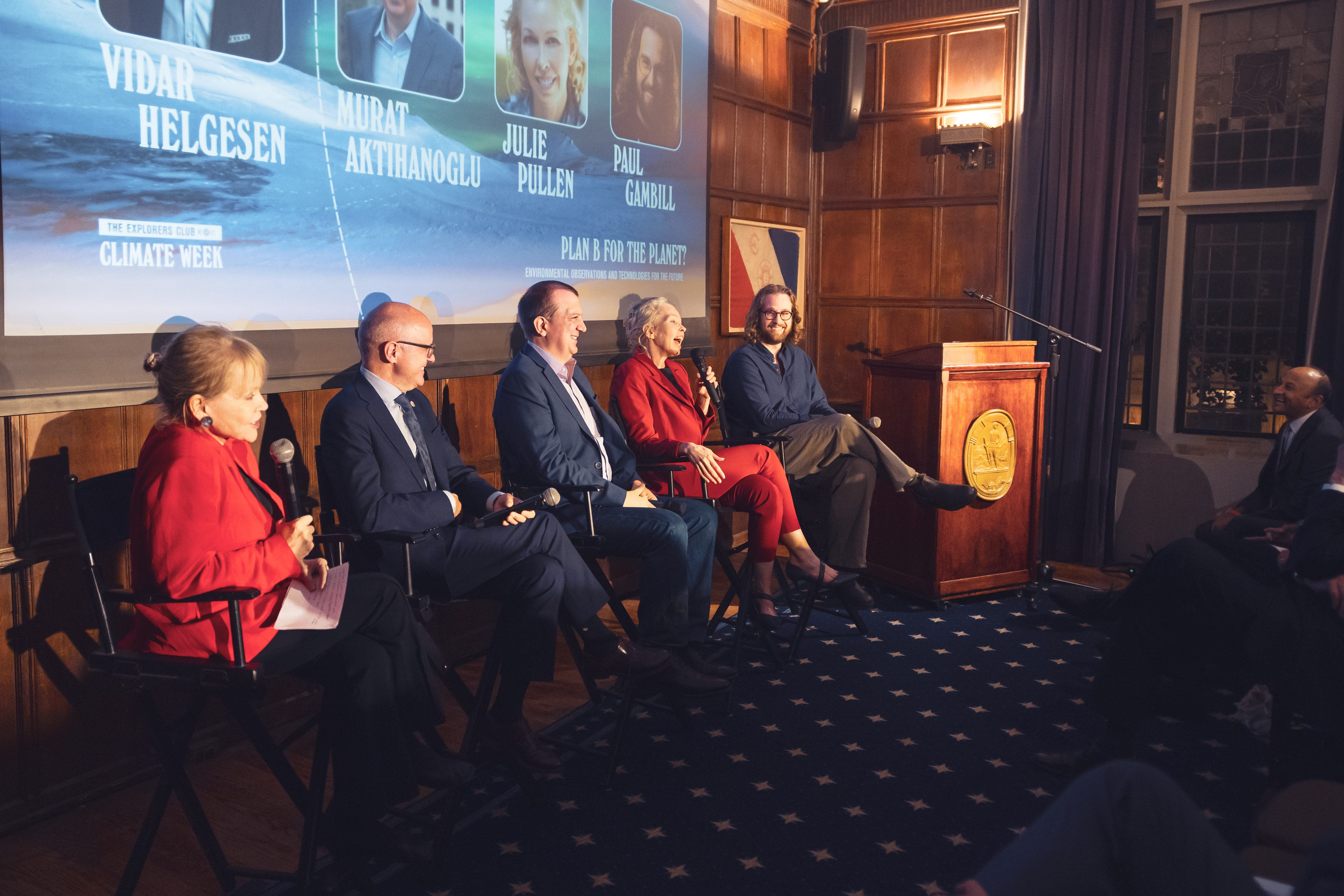
I walked into the Explorers Club last Thursday night eager and excited to join the panel for the session “Plan B For the Planet?” (hosted by Marianne Hagen of the Seabed Curtain Project—go listen to our podcast together here) because I knew it would be a room of people extremely interested in understanding the realities of where the climate change situation actually is. The Explorers Club was founded in 1904 to promote scientific research in the field, and its members are a concentrated group of people who value natural systems, conservation, and experiencing the wild diversity of life Earth has to offer. In other words, I could not imagine a group more ready to hear about what we have to do to stabilize the Earth systems most at risk.
And so, to a fully packed room in a building whose walls are lined with the famous Explorers Club flag, elephant tusks, wooden sleds from polar expeditions, and photos and memorabilia from 120+ years of adventurers, I was asked, what does Plan B mean to me?
The crowd was very climate conscious but not necessarily aware of things like tipping point risks or climate interventions. When I mentioned stratospheric aerosol injection (SAI), I literally heard people gasp and groan, and when I said that fewer than 1,000 people in the world work on this stuff, there were more gasps. It’s been a while since I’ve written any sort of top-level explainer, so for new subscribers, this article is a summary of how I view the situation.
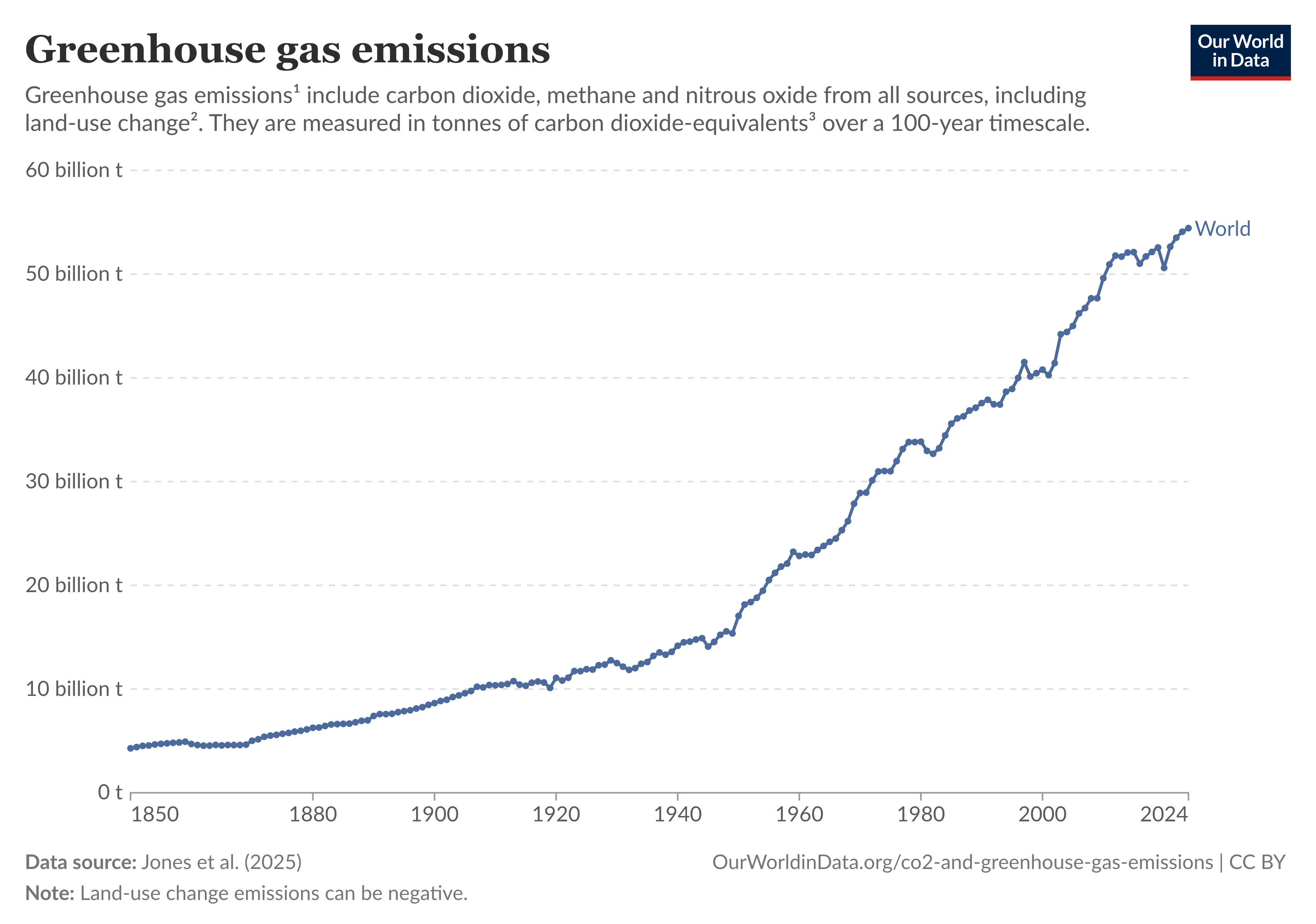
We are currently emitting about 40 billion tonnes of carbon dioxide every year, and that number has not yet peaked. If you include the warming impacts of superpollutants like methane (a significantly worse greenhouse gas), then we are emitting the equivalent of approximately 55 billion tonnes annually. This number has not peaked in the data yet. Mitigation (the word the international policy community uses to mean “decarbonize”) has slowed down the rate of growth (which is a victory), but it has most certainly not reversed the trend yet.
Back in 2015, I thought, “Hey, it’s weird that I don’t see any significant activity working on pulling the CO2 back out of the air,” and so I embarked on building a business model around creating financial incentives for removing that legacy atmospheric CO2. For complicated reasons (and I have explained the longer background context here), the carbon dioxide removal (CDR) market has not reached scale. In 2015, I assumed that a combination of technological improvements, a shift in attitudes, a change in the regulatory environment, and financial incentives would result in a situation where CDR was reaching over 1 billion tonnes removed per year by 2025, and we were well on our way to scaling to tens of billions. The sad fact of the situation is that CDR has done nothing of the sort, and while amazing progress has been made in building an industry that has seen billions of dollars invested in hundreds of companies, our actual atmospheric impact has been effectively negligible.
Meanwhile, warming has accelerated. Earth’s energy imbalance (meaning, energy in exceeds energy out) has roughly doubled since the early 2000s, due to several factors, including feedback loops in Earth systems that are making things worse (decline in reflectivity, fewer clouds, less sea ice, etc.), and, perhaps counterintuitively, a decline in air pollution because of regulatory changes.
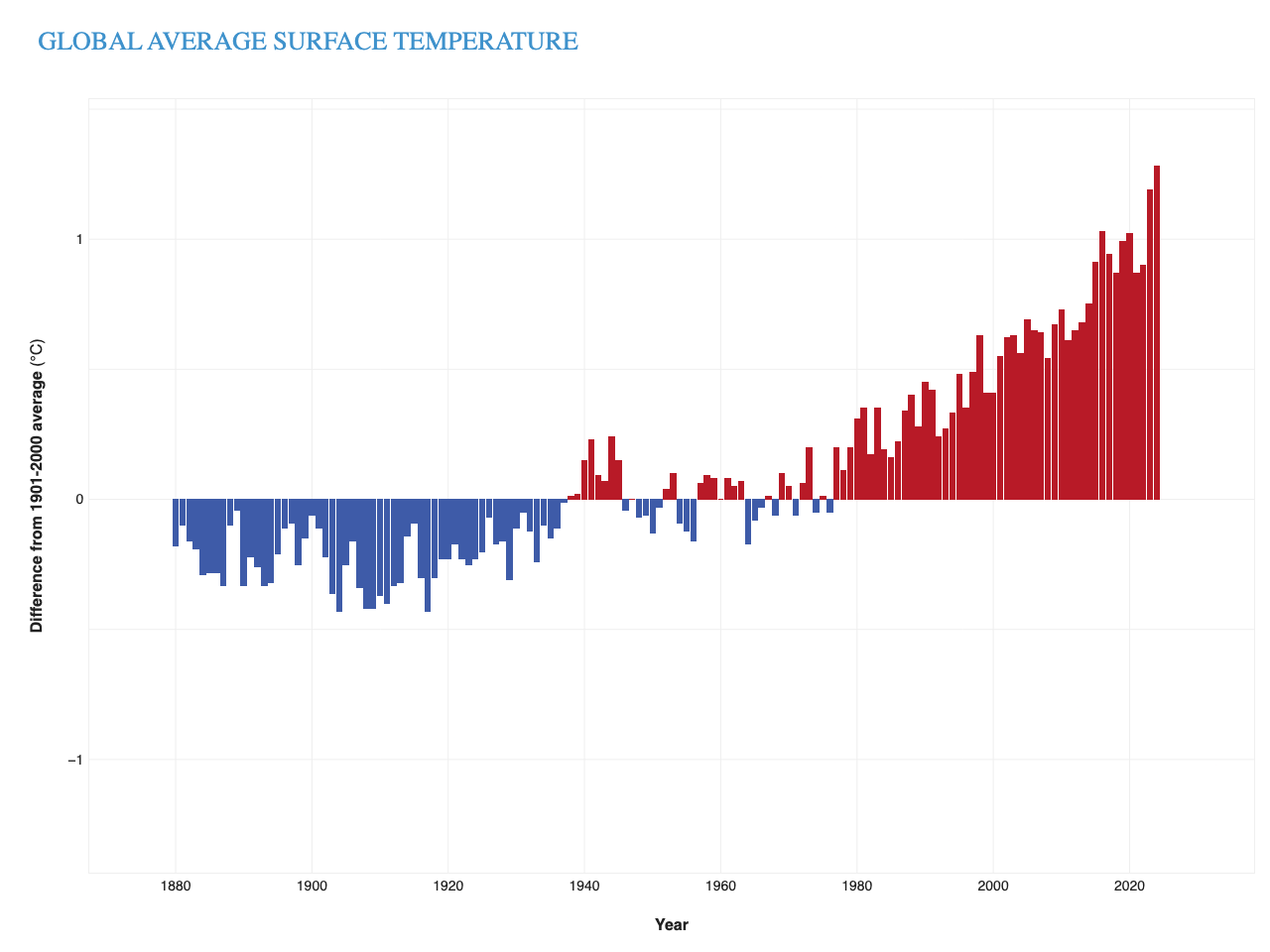
Temperatures exceeded 1.5°C above the pre-industrial baseline for the first time in 2024, and we are going to remain in overshoot for the rest of our lives.
The thing that really worries me is that if we merely rely on Plan A (cutting emissions and removing some amount of legacy atmospheric emissions), it is going to take too long, because there are feedback loops, tipping point risks, and Earth systems and human systems at risk of collapse, all of which could cause catastrophic damage to the planet and to our civilization.
If we do not take extraordinary action to protect coral reefs, prevent permafrost from melting, ensure food systems produce enough food for billions of people, restore sea ice, and prevent glacier and ice sheet collapse, then I worry that we will face what is known as derailment risk. That is, if we are already paying trillions of dollars for adaptation measures because of sea level rise, extreme storms, increased fires, etc., then what happens to our insurance markets? To our disaster response budgets? And then if we are getting punched in the mouth repeatedly by the effects of climate change, will we still be able to afford to finish the job of mitigation and decarbonize our society? Will our democratic governments be able to maintain legitimacy in the face of increased migration and citizens upset with all of the damages they experience?
The fact of the matter is, we have less time than we think to take action. These systems could collapse well before we even hit something like 3°C of warming. Fortunately, there is a field of people including scientists, policy experts, philanthropic and government funders, insurance and finance professionals, startup founders, and engineers working on the response options. We call this field Earth systems stabilization, or just stabilization for short.
The major risk areas that most people working in this field are concerned about are:
Arctic cluster risks generally, because the Arctic is warming four times faster than the rest of the planet. This includes sea ice loss, AMOC collapse (the Atlantic Ocean current system that includes the Gulf Stream), melting permafrost, increased boreal fires, and more.
The Amazon turning into savanna because of drought and the shutdown of the hydrological flows that renew the forest.
Coral reef collapse (we are unfortunately already facing this).
Sea level rise from both thermal expansion (water takes up more volume as it gets warmer) and ice sheet melt.
And probably the most important of all, the darkening of the Earth as we lose reflectivity because of the effects of climate change.
We have options!
There are proposals for how we might respond to almost all of these risks. Some are better researched than others, but in all cases we as humanity would certainly benefit from an increase in the amount of research and experimentation. These include:
Refreezing Arctic sea ice by pumping water on top of the ice in winter.
Blocking warm water from melting the underside of the Thwaites Glacier in Antarctica.
Thinning high-altitude cirrus clouds so that infrared energy radiating from the Earth can escape to space.
Spraying salt aerosols and/or upwelling cold water to dissipate the energy in large hurricanes.
Spraying salt aerosols to increase the reflectivity of certain clouds, both as a cooling method regionally and potentially as a way to shade coral reefs.
Rewilding the Arctic with bison so they trample down the snow that insulates the ground and prevent permafrost from melting.
Refilling inland basins and/or seas such as the Caspian Sea in order to put the water from sea level rise somewhere that lowers the overall level.
The big one: injecting aerosols into the stratosphere (SAI) so as to reflect 1% of incoming sunlight and potentially reduce the overall temperature of the planet by 1°C.
And there’s an even farther-out concept for putting a sunshade in space to function the same way (block incoming sunlight), without the atmospheric changes. Here’s a podcast I recorded with that team.
This newsletter and podcast exist to discuss these ideas with the people working on them, and I have a large back catalog you can dive into to learn more. But perhaps start here: How to Learn Everything You Need to Know About Climate Cooling.
I co-led a research study in early 2026 that found the single biggest barrier to researching these climate interventions is a lack of philanthropic funding. The second largest problem is that there are simply not enough people. We estimated that fewer than 1,000 people worldwide work on these issues in a full-time capacity, and those who do work on them are operating on a grand total of about $25 million of funding per year. This is woefully inadequate for responding to these risks, and it is incredibly important that we grow this field with as much haste as possible. If you are reading this and have philanthropic capital to deploy, the single highest-leverage thing you could do right now is fund research and development into climate interventions and Earth systems stabilization.
Climate Week NYC 2026
The event at the Explorers Club was the highlight of my week, and it was also the conclusion for me before heading home to Seattle. What I saw this year in NYC was heartening, though. By rough count, there were nearly twice as many events as last year that focused on stabilization. And at those events, I heard much more openness and bold statements about the need for stabilizing these Earth and human systems. I heard more voices saying that we must consider SAI as a response to temperature overshoot. The taboo around this is not yet broken, but it has definitely weakened. I wrote a note summarizing my observations from the week:
Back to the question, what does Plan B mean to me? A hypothetical future deployment of SAI or any other climate intervention, in my view, is absolutely not giving up on mitigation or carbon removal. Those are not optional, and interventions are not a replacement solution. Keep in mind that interventions come with their own risks and downsides and costs, and they only make sense to consider when comparing the risk of inaction to the risk of action.
But in my view, we simply must figure out how to stabilize these systems safely. It is a problem to be solved, and if in the course of research or discussions around governance we find some roadblock that can’t be overcome, then we must try another path until we find a more viable response option. If we don’t find ways to preserve our capacity for mitigation of climate change, then we are in for a very bad time. Plan B is not really “Plan B,” then. Plan B is how we make it possible to complete Plan A.
Nice one Ben - excellent explainer
Thanks for the excellent summary on where we are, and where we should be. I just have one comment. We should really stop referring to “Plan B”. You yourself come to this conclusion at the end of your article - but without explicitly saying so. “Plan A” is there, and we have to implement it (we are far from it). Because we have taken so long, we have to add a number of corrective measures to Plan A, such as removing massive quantities of carbon from the atmosphere; seriously doing heat management everywhere; much more on adaptation; and albedo management at local, regional and potentially at global levels. And let’s not forget that all this is still just within the “climate bubble”. The oceans, biodiversity, the land, etc., will all need their specific but linked stabilization plans in order to reach Earth System stabilization - without which sustainable development will not be possible. There is a lot to do!