


In addition to The Overshoot Era, I also co-host a podcast about stabilization and how to scale the field with Susan Su of Climate Money. So after you’ve digested this framework, I’d suggest listening to the latest episode of Tail Risk. Subscribe there for show notes and new episode notifications.
Subscribe: Apple Podcasts | Spotify | YouTube | Overcast | Pocket Casts
The stabilization field works on risks like ice sheet collapse, a weakening Atlantic circulation, declining Earth reflectivity, and thawing permafrost, and on what we might do about them. In the readout from the Global Risk and Stabilization Summit, ARC set two goals for it: ten times today’s funding by 2030, and 50,000 people or more working in it by 2035. Those numbers are huge. Estimates of the field’s philanthropic funding today run from a few tens of millions of dollars a year to about $100 million, so ten times that is somewhere between a few hundred million and a billion dollars a year. And fewer than a thousand people make up the core of the field right now, so 50,000 is more than fifty times that in under ten years.
Goals like these call for an all-hands-on-deck kind of urgency, and if we’re going to really do this, we need to be systematic about how we get there. In my takeaways from the readout I wrote about the summit workshop where tables imagined it was 2050 and worked backward to what had been built to get there. I want to do the same thing for the field itself, and what I’m offering is a framework I’ve been calling Legitimacy and Growth, which I hope people and organizations can use to define their own strategies. Here’s the short version:
People in this field hold at least five different theories of how this field grows, and I think all five are correct.
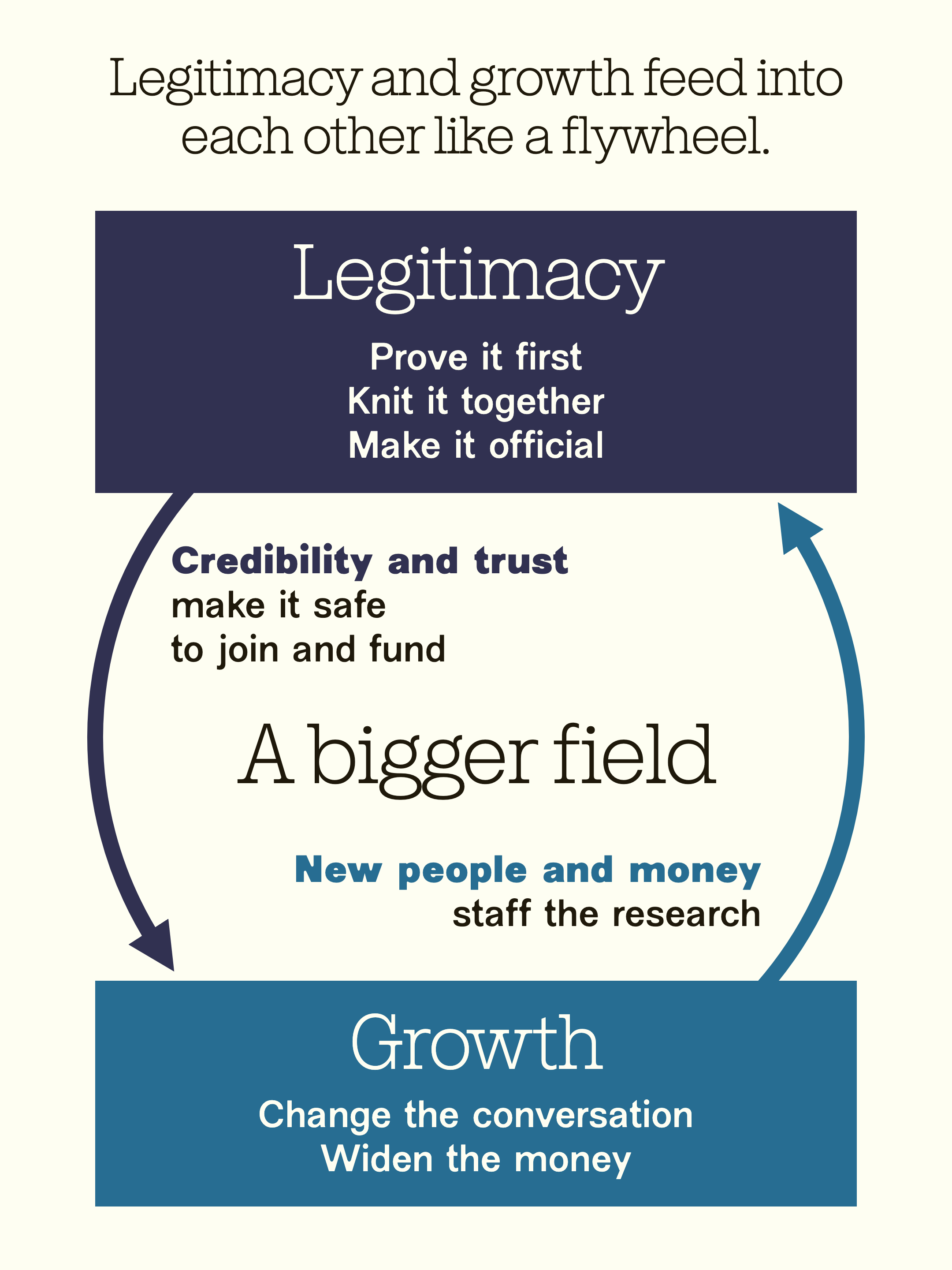
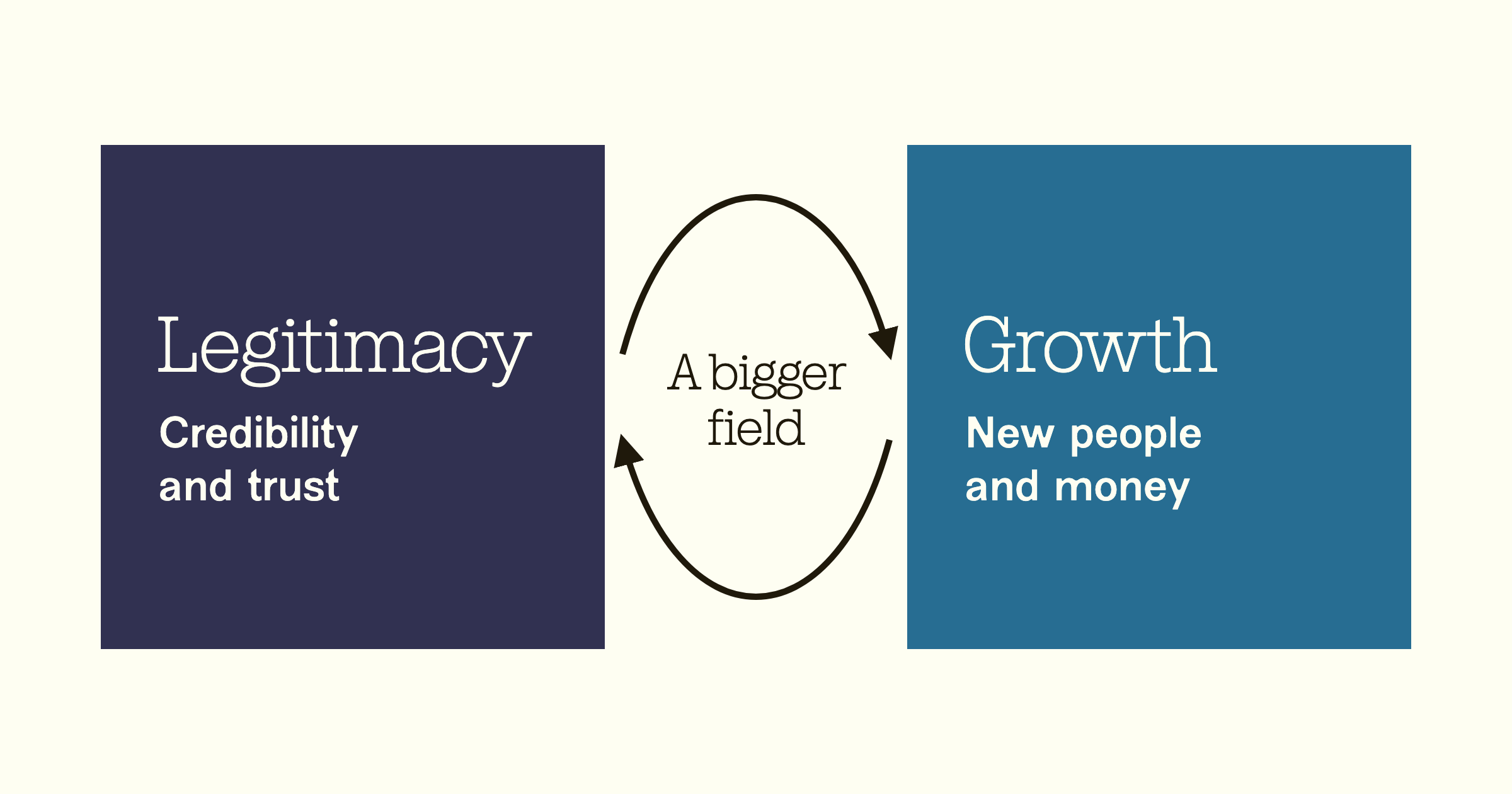
These five theories of change sort into two kinds of work. Legitimacy earns the field credibility and trust, and growth brings new people and money in. The two feed each other like a flywheel.
Working backward from the goals, I think growth is the side that has to get much bigger, on top of everything already happening.
Five theories of how the field grows
Over the past year, Ben Lachman and I have asked people what’s holding this field back, in interviews, at the summit, in our attendee survey, and in a lot of conversations across the field. Out of all of that, I found five different theories of change that people hold about how to actually build out this field, and I gave them names the way you would in scenario planning. Most people we talked to hold more than one. I think they’re all correct in their own way, and, more importantly, they all point at doing different things. We need all of them to grow this field fast enough to respond to the actual risks in these Earth systems. They are:
Prove it first. The field lacks credible science on the risks and the possible responses, so the answer is better observation, synthesis, and research. This was the most settled view at the summit, and from what I’ve seen, it’s the theory most funders already act on. Credible science doesn’t recruit people or money by itself, though.
Knit it together. The field is a set of separate communities working on separate risks who rarely meet, so the answer is convenings and coalitions, with more seats for the Global South and frontline groups. That was a lot of what the summit was for. But convenings in general mostly reach people who already know to come.
Make it official. No government or institution owns these risks, so the answer is government programs and mandates. Iceland designating a possible AMOC collapse a national security risk is the kind of step this theory points to. Governments move slowly, though, and policymakers topped attendees’ list of who was missing in Reykjavík.
Change the conversation. What holds the field back is political and public permission more than technology, so the answer is a public voice, explainers, and media. It’s what I’ve been working on with this newsletter and the podcast. The risk is that permission built ahead of the science turns into backlash.
Widen the money. There are too few funders, and most potential funders don’t know about the field yet, so the answer is funder education, introductions, and new kinds of capital, which doesn’t just mean venture capital. Where the money comes from affects credibility, so it matters which new money comes in, too.
Legitimacy and growth
The five theories fall into two different buckets. Prove it first, Knit it together, and Make it official are in service of legitimacy, which means scientific credibility, institutional trust, and the policy side. Change the conversation and Widen the money are about growth, which means getting more people coming in and more new sources of philanthropic and public capital. It also means onboarding people so they can get up to speed quickly on the state of the science, the politics, and the institutions involved.
And I think it’s a flywheel, because they both feed into each other. The legitimacy makes it possible to grow, and when you grow, that increases the capacity to do more legitimacy-building work. The science and the convenings are still the core of the field, and growth is how people outside it hear about that work and join in. But growth that gets ahead of the science invites backlash.
Working backward from the goals
There’s been a lot of work on the legitimacy side, in some cases for decades, and a lot of groups are doing really good work there right now. It’s the reason there’s a field anyone wants to join, and I don’t think anyone should stop doing any of it. The 2030/2035 targets measure people and money, but I haven’t met anyone who thinks the field gets to 50,000 people without the trust that legitimacy work builds.
But when I work backward from the goals, I keep landing on growth. How do you 10x the money? Even if every funder already in the field tripled their giving, the other seven times would still have to come from people who don’t fund this work today. And most of the 50,000 people the field needs by 2035 aren’t working on this yet, and most of them haven’t even heard of it. So if we’re going to work backward from those goals, I think growth needs a systematic approach of its own, on top of everything already happening.
Carbon removal is the closest thing I’ve seen to this flywheel turning, and there it turned on both sides at once. The IPCC’s 2018 report found that every pathway to 1.5°C relied on carbon removal. Stripe committed to buying CDR credits in 2019, which started to put it on the map, and my friend Tito Jankowski started AirMiners, which gave a lot of the newcomers a place to land. In 2022 a group of buyers launched Frontier with a $925 million commitment, and more money and more people kept coming in. If you want more people coming into a field, they need to be able to make an income off of it. The stabilization field will have its own businesses too (though I’m not confident I can forecast what they’ll look like yet) so for now most of that income will have to come from research funding, philanthropy, and public programs.
New people need a place to land when they arrive. Working groups are a really good starting point, because you can give people an area to dig into, like finding out what everyone has to say about a subject and pulling it together into something useful. Beyond that, there are too few on-ramps today for researchers, students, founders, or people changing careers, and new funders need help understanding the field quickly enough to act.
Questions worth working on
If we take the goals seriously, these are the questions I think the field should be working on:
What should the on-ramps look like? They don’t have to look like existing NGOs or agencies.
How does the field reach funders who don’t know about it yet? Individual donors, family offices, and people outside tech and climate need a different approach.
What kinds of capital fit what kinds of work? Some of this work could draw public money or investment, and some is only fundable by philanthropy.
What keeps newcomers in the field after their first event? Many of the people who came to Reykjavík want to keep working on this, and they need a way to do it.
How does the field grow fast without getting ahead of its science? As more people and money arrive, research governance and the shared science record have to keep up.
How do the countries and communities that aren’t in the room yet help shape where the field goes? Attendees in Reykjavík named China and voices from the Global South among who was missing.
If you’re working on any of these, or you’re new to the field and trying to figure out where you fit, let me know in the comments!
A very useful insight, Paul!
Paul, you need stickers to place everywhere, including on people's backs that say, “STABILIZE THIS!” :)