


I helped organize the Global Risk and Stabilization Summit in Reykjavík last month, and these are my own views, not ARC’s.
The readout from the Global Risk and Stabilization Summit is out, along with the results of our attendee survey, and I’m really pleased with how both turned out.
The summit ran for three days in Reykjavík in mid-October, with more than 250 people in attendance. We held it in Iceland partly because Iceland has formally designated a possible AMOC collapse a national security risk.
We organized the programming so that the first day was oriented around discussion of the different Earth system risks, with tracks on the Arctic and AMOC, sea level and ice sheets, the biosphere, and Earth’s reflectivity. On the second day, the sessions turned to what we actually do about those risks, with fifteen sessions on topics like governance, finance, engineering, and how to talk about this work, and I wrote about one of them in Thinking Bigger About Stabilization. The third day was a smaller, hands-on workshop, which I’ll get to below. You’ll find complete descriptions of every session as well as the workshop structure in Appendix B.
This readout is a report on what participants said across all three days. It covers the main findings, where people disagreed, the open questions, and what attendees told us in the survey, and it ends with our own take as organizers on what should come next. Many people asked me in the months leading up to the summit whether it would be recorded or streamed for those who couldn’t attend, but since it operated under Chatham House Rule, that wasn’t an option. Instead, we’ve produced this report in a way that doesn’t name who said what, but summarizes the themes of what was discussed. For those who did attend the summit, one of the challenges was that there were so many interesting sessions happening in parallel, and I’m sure I’m not the only one in feeling like there were really interesting conversations I missed but would have liked to have participated in or listened to. This report helps us all learn about what was said across the entire summit.
I also want to point out that we at ARC are working with several dozen co-authors on a synthesis report on the state of the field. This readout is not that report, which is still forthcoming.
What I missed
Here are three of the sessions I wish I’d attended.
To me the interesting takeaway from the finance and security sessions is that people who manage risk for banks and insurers know that tipping points and catastrophic climate risk are serious, but the models and scenarios they rely on mostly leave those risks out. As I read it, whoever starts pricing them in first gets punished for it, losing business to competitors who don’t, so it’s a collective action problem. The security session made a related point, that a climate science assessment is not the same as a risk assessment.
The biosphere and ecosystems don’t get as much attention in this field, and the biosphere track showed how little we know. One speaker said that if interventions were ever used, “we just don’t know what will happen to the biosphere,” because the data are too thin to model it. Even basic questions are open, like what happens to ecosystems when temperature and CO2 stop moving together, and ecological research on interventions has no obvious home in US federal funding.
Derailment risk—the chance that the consequences of climate change derail climate action itself—is what motivates me to work in this field, so I was sorry to miss the session on stabilizing society. Tables there worked through how societies could prepare for shocks like famine or financial panic, with ideas like stockpiles, redundant supply chains, and drills. One participant also said that social stabilization, as distinct from stabilizing Earth systems, had barely been discussed at the summit.
The workshop
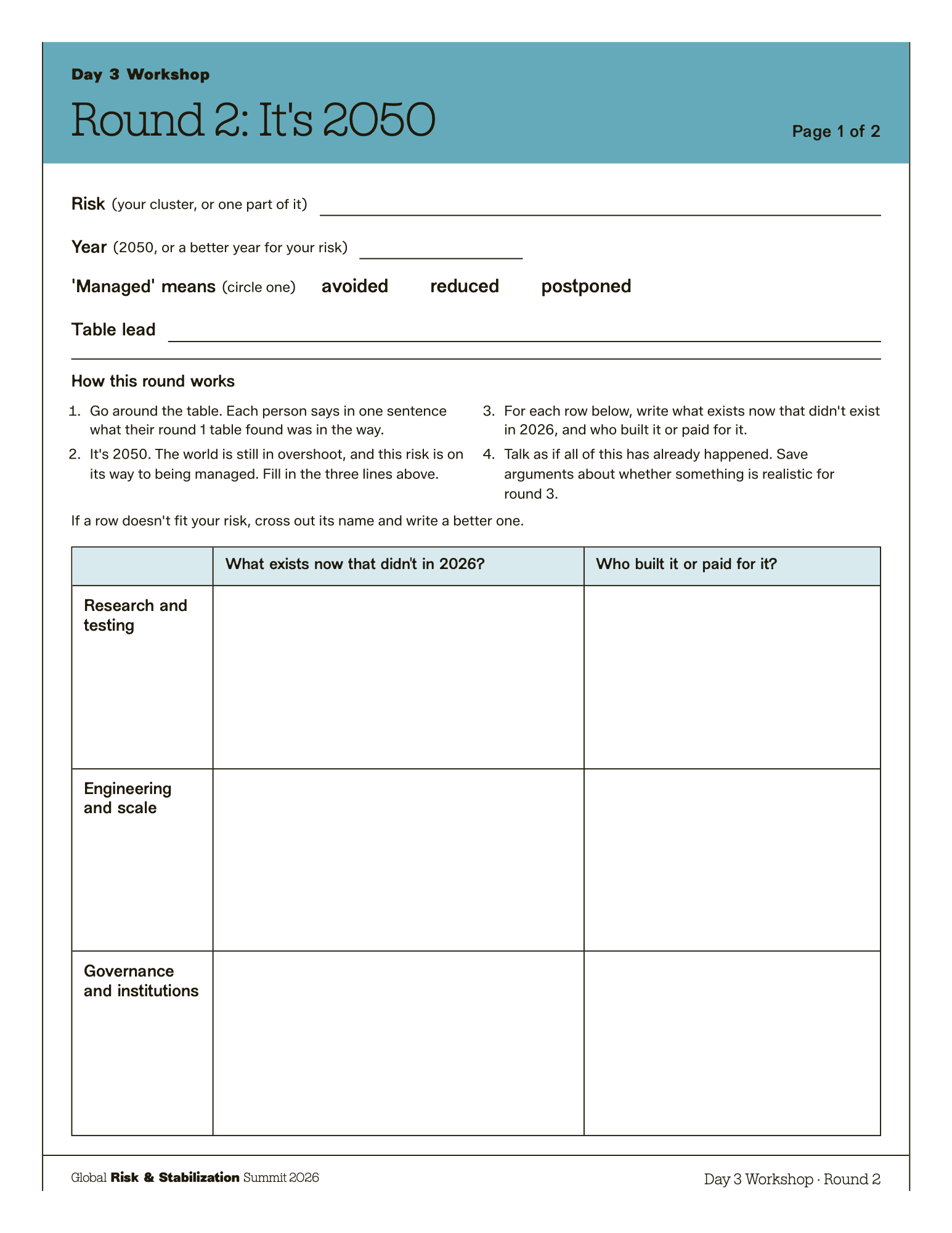
I was in some ways most excited about the workshop day, because it brought leaders of organizations working in this field together to work through some of its big open questions. To do that we set up a backcasting exercise, and it turned out to be really fruitful. About 70 people sat at tables organized by risk, like AMOC or Earth’s reflectivity, imagined it was 2050 and their risk was on its way to being managed, and worked backward to what had been built to get there and who paid for it.
The worksheet each table filled in for the 2050 round:
A few results stood out to me.
Five of the six tables said their risk had been reduced by 2050. None said postponed, and the one table that circled avoided crossed it out.
When we asked what would survive a change of government, tables picked local and regional measures, profitable projects, and research. No table picked a global intervention.
Tables found it easier to say what would exist in 2050 than who would pay for it or how the public would come along.
Asked what has to happen in the next two years, four of the six tables wanted a shared, authoritative reference on the science and the options.
The day ended with a really interesting discussion about whether the field needs a more public voice, up to and including an advocacy organization, or whether going public now would pull the issue into partisan camps. People landed on both sides.
What attendees told us
About 90 people answered our survey afterward. (There are some very cool charts on that page, so don’t miss that survey insights link.) Here’s what I found most interesting.
Nearly two-thirds of respondents had been in the field less than five years, and most of those newcomers are mid-career.
Newcomers and veterans named different gaps. Of the 18 people who said the field’s biggest gap is public and political support, 15 had been in it under five years, while the people saying the field needs to narrow down which interventions are actually worth pursuing were mostly veterans with ten or more years.
Policymakers topped the list of who was missing, followed by voices from the Global South and critics of interventions. DSG made a related point in their post about the summit, that “who is in the room depends on where the room is,” which is part of why it’s important to plan regional meetings in 2027.
People wanted fewer parallel sessions and more unstructured time to network with each other.
Some wanted more room for the rest of the field, like regional interventions, the biosphere, and preparedness, so that SAI wasn’t the thing every conversation came back to. One respondent wrote that “SAI was looming across every area like an anchor.”
Another respondent described the room as “a diverse but committed crowd many of whom have often felt the need to apologise for their work before explaining what they do,” which sums up the permission space problem pretty well.
What comes next
Our goal was to get people to see the field as a field, to feel like they were part of something, and to see some coherence developing, and I think that happened. One thing that surprised us was how many people want to keep going, with 56 survey respondents saying they’d join a working group, 29 offering to lead or co-lead one, and a lot of interest in mapping the field more fully. I expect we’ll hear about new collaborations and projects that came out of Reykjavík over the coming months.
I’ve been using the readout to plan the next things I’m working on, and I hope you’ll find it useful in the same way. Video of the opening talks is coming soon. If you want to get involved, there’s a form at the end of the readout.