



I’ve been recommending Tom Harris’s Climate Uncovered Substack for quite a while, and I really encourage you to read his stuff. He does these fantastic scientifically-detailed explainers of various topics that sit within the same intersection of overshoot and climate interventions that I cover here. Recently we decided to work on a piece together, and what we landed on was a thought experiment to ask the question: what would the world look like in 2050 if we muddle through emissions cuts and deploying various stabilizing interventions, but for some reason we couldn’t implement SAI? You’ll see below how we laid it out with two different future scenarios and what we picture happening. But what I really want you to take away from this is a higher-level perspective on how to think about sequencing and what needs to happen in the next several years, as right now is the most amount of leverage we are ever going to have for influencing Earth systems and human systems outcomes from climate change. Tom wrote a bonus post over the weekend, Highest Possible Ambition Pathway: Plausible Hope or Dangerous False Security?, that is a good prelude to this piece and if you have the time, I suggest you read it first.
And, as always, if you have particular expertise in any of these domains, and believe we got something wrong, please leave a comment.
-Paul
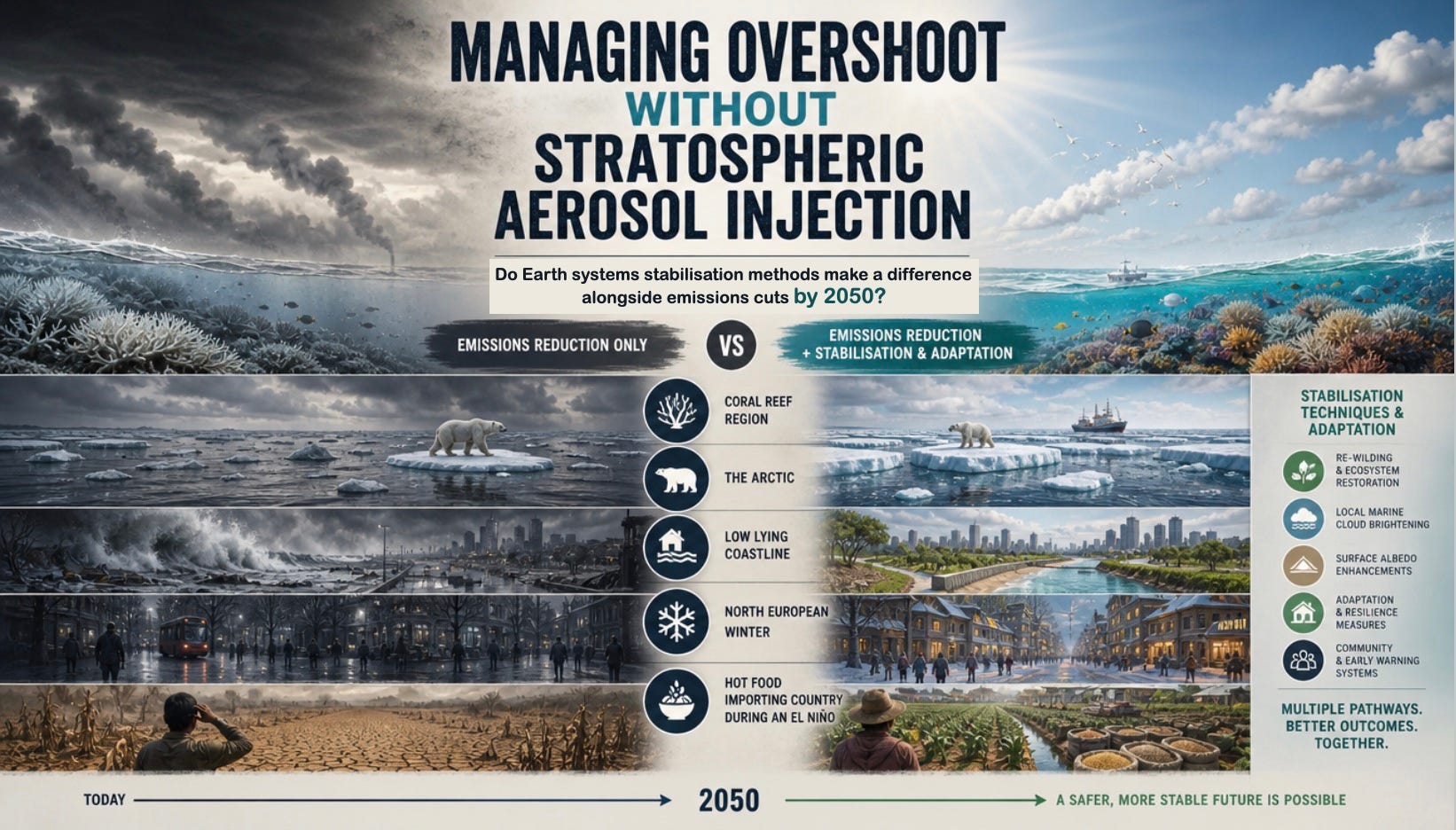
The UN Environment Programme has released two major reports in the last month. First was the Overshoot Spotlight Report, followed by the Emissions Gap Report 2026. They both contain the same stark message. Humanity has failed to prevent Global Mean Surface Temperatures (GMST) from exceeding the 1.5°C limit set by the Paris Agreement in 2015. What’s more, they both show that even if all countries deliver their current Nationally Determined Contributions (NDCs) and net-zero pledges, GMST will pass the upper 2°C limit.
The reports do however provide pathways to manage the passing of 1.5°C as a temporary ‘overshoot’ during which temperatures would climb to 1.8°C but then drop below 1.5°C by the end of the century. These pathways are challenging to say the least, but they rely solely on decarbonising the global economy and deploying Carbon Dioxide Removal (CDR). They do not include any Earth systems stabilisation or cooling techniques.
Much of the conversation about deploying cooling technologies assumes it would come from stratospheric aerosol injection (SAI), which would spray tiny reflective particles high in the atmosphere to dim sunlight slightly and cool the planet. That’s for good reason, since it’s the one option that could help with nearly all of the risks of overshoot at once, and it could plausibly start within the next decade. But what if, for a variety of reasons, we decide not to do it? Maybe we can’t get over the hurdles around governance and decision-making, or the geopolitical risks look too high, or somebody starts it and then we decide to stop, or it has consequences that the models didn’t show. What then?
The stabilisation field does however have many more potential tools than SAI. We wanted to play out how effective those tools would be in managing overshoot without the global cooling benefits from SAI. In this article we compare two futures in 2050, one that follows the UN path alone, and one that decides against SAI but uses every other stabilisation and adaptation option it can, and look at what each would mean for five domains around the world.
The two futures
We picked the 2050 horizon as it is relevant to most people alive today. If you took out a new mortgage, you could still be paying it off in 2050. Kids in pre-school today will just be starting their careers, and you’ll be a similar age to that of your parents now. This is not the distant future.
Future A, the UN path. Emissions follow the UN’s Highest Possible Ambition pathway: deep cuts including methane, CDR scaling up, and the adaptation measures already planned. Warming peaks around 1.8°C. The scenarios are built from the UNEP published projections.
Future B, everything but SAI. The world decides against SAI but does everything else: the same emissions path, plus every regional stabilisation intervention we could plausibly have under way by 2050, together with adaptation that goes well beyond today’s plans. This scenario is built from feasibility and modelling studies, and we flag wherever we go beyond them.
Neither future uses SAI, and we assume the same emissions in both, so Future B doesn’t change the peak temperature or how long the overshoot lasts. By stabilisation we mean measures that act on Earth systems themselves, like brightening clouds, thickening sea ice, or moving water out of the ocean, and by adaptation we mean protecting people and places from the impacts. Future B gets all of Future A’s adaptation plus a lot more, and we label which is which. A world on the UN path would probably do some of that extra adaptation as well, even though nobody has planned or budgeted for it yet, so we count it in Future A. As far as we know, nobody has modelled these two futures side by side, and we’d like to see someone do it in a peer-reviewed study.
Why even Future A is generous
Firstly, some observations about the paths suggested by the UNEP reports for minimising overshoot and their level of credibility.
The UN’s Highest Possible Ambition (HPA) 1.5°C overshoot scenario is still aligned with the long-term temperature goal of the Paris Agreement to limit global warming to well below 2°C, while pursuing 1.5°C. To get on such a pathway, global greenhouse gas (GHG) emissions must be reduced by 18 per cent by 2030, 45 per cent by 2035 and 69 per cent by 2040, all relative to 2025 levels. By contrast, the full implementation of the new nationally determined contributions (NDCs) submitted by around two thirds of all countries would reduce emissions by 5–8 per cent by 2030 and 11–15 per cent by 2035 relative to 2025 levels. Meanwhile the 2025 World Energy Outlook published by the IEA suggests steady or even increasing oil demand by 2035.
Figure 1 shows these trajectories along with the NDCs and current policy trends. The pathways require an immediate and radical shift in global emissions. Note the dip in 2020 due to the COVID lockdowns. To achieve even the 2°C pathway, humanity would need to replicate that level of change every year from now on—cumulatively!
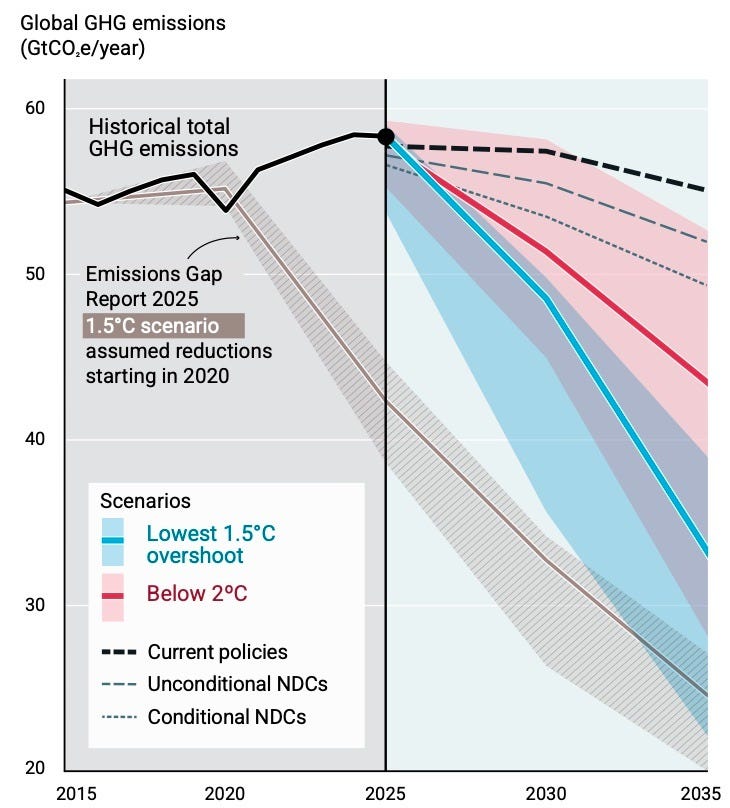
In addition to severe emissions cuts, the lowest 1.5°C overshoot scenario creates a need for aggregate CO₂ removal from the atmosphere and its permanent sequestration of roughly 320 GtCO₂ over the course of this century in order to return warming to 1.5°C by 2100. This is however based on achieving the emissions cuts above.
The second problem with Future A is its treatment of the current acceleration in global warming. The Earth’s energy imbalance (EEI) is increasing linearly, driving up the energy accumulation by the climate system at an increasing rate. This leaves residual committed warming in the pipeline. Only when the EEI returns to zero will warming stop and only if it can be driven below zero, will the planet cool. Tom dived into this argument in a recent post. Our analysis here is to compare the two futures at 2050. By that time, the UN scenarios have us at global net-zero with carbon removal actively reducing the atmospheric CO₂ content. We’ll leave you to consider the likelihood of this while reading the following sections.
The five domains
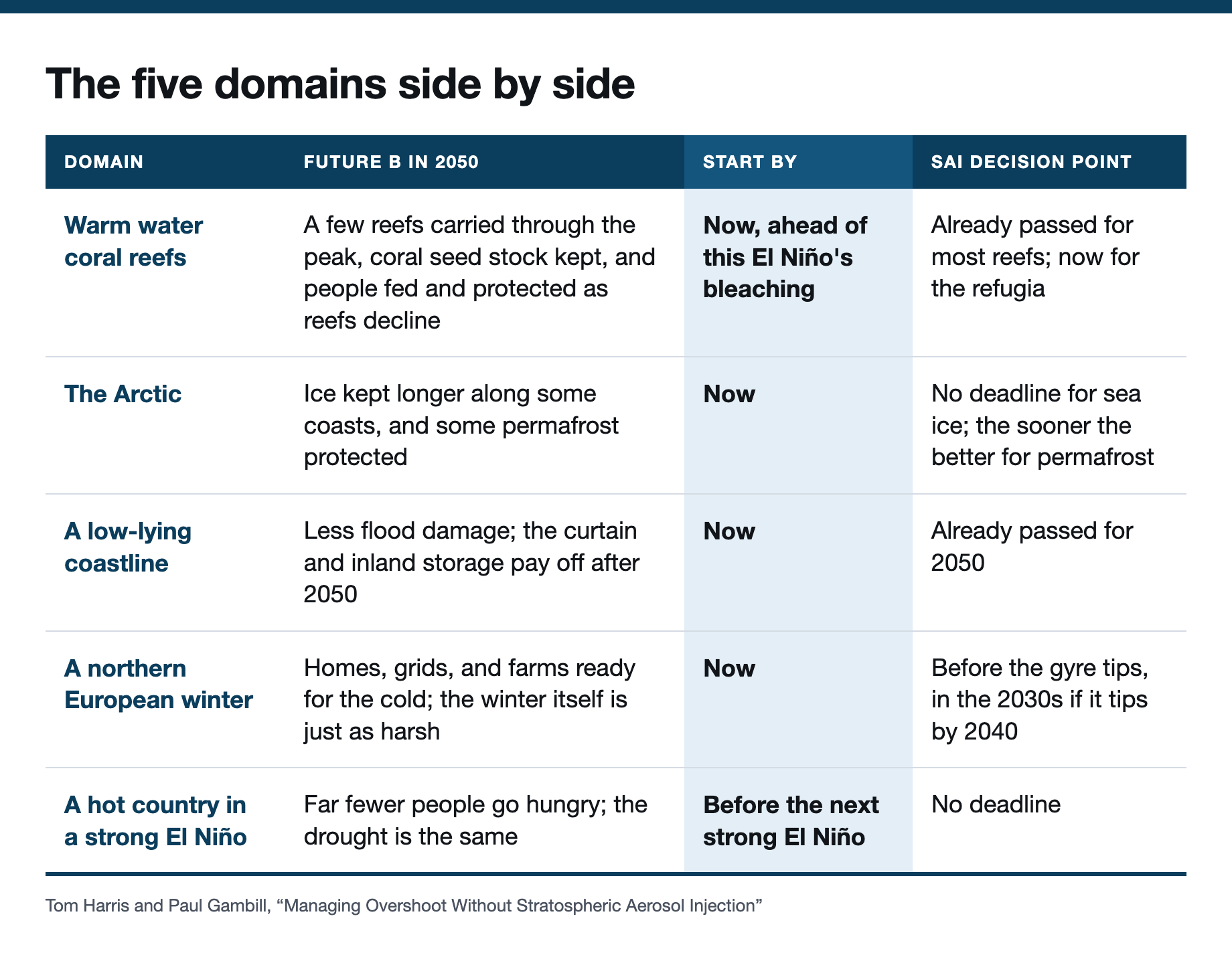
Each of the five domains below ends with two timings: when the Future B work has to start in order to matter, and the SAI decision point, which is the last point at which deciding to use SAI would still make a real difference there by 2050, allowing for the years it would take to get going. “No deadline” means SAI would help whenever it started.
Warm water coral reefs
This includes areas such as the Great Barrier Reef, the Indonesian and Caribbean reef systems as well as the Indian Ocean reefs. These ecosystems provide food and economic support for up to a billion people. For nearly 300 million people, they provide their primary source of protein and income, as well as protection from coastal erosion.
Future A
Coral reefs are highly sensitive to water temperature. Even a 1°C spike in water temperature can cause bleaching whereby the coral polyp ejects its algal symbiont. Although not dead at that point, the polyp slowly starves to death unless water temperatures cool enough to allow their algal partners to return. Successive bleaching at closer time intervals leaves less recovery time and greater loss. The Global Tipping Points report of 2025 puts the GMST threshold for corals passing a tipping point, leading to their functional extinction, at 1.2°C. Mass mortality is already underway with a 2023-2025 bleaching event affecting every ocean basin with 83.7% of coral reef area experiencing bleaching-level heat stress by April 2025. The 2026-2027 super El Niño will also see extended devastation.
In October the International Union for Conservation of Nature published its first global assessment of shallow water coral reef ecosystems. More than 250 experts reviewed 127 large reef regions worldwide, covering over 180,000 square kilometres of coral reef in more than 80 countries and territories. Of those 127 regions, 122 (96%) were classified as Critically Endangered.
By 2050, even under Future A decarbonisation, persistent temperatures above 1.5°C for over 20 years will have pushed these ecosystems into regional extinction with only a few isolated refugia (localised safe zones) surviving where cold upwelling waters provide sanctuary. All the benefits from food production, tourist income, and erosion protection will be lost. This is likely to lead to significant migration pressure as large populations are forced to abandon low-lying tropical regions in search of food, employment and shelter, on top of sea-level rise.
Future B
Stabilisation. We’re already past the threshold for most reefs, so even in Future B most of them are lost or failing by 2050. What Future B can do is carry some of them through the hottest decades. Scientists at Southern Cross University have been testing marine cloud brightening on the Great Barrier Reef since 2020, spraying a fine mist of seawater into the air so the clouds over the reef get brighter and shade it during marine heatwaves. This one is challenging. The trials have shown the spray can change the clouds, but not yet that it cools the water, and each sprayer still needs to produce about ten times as many particles a second. A 2019 estimate put cloud brightening over the whole reef at A$107 million to A$338 million a year. In Future B it runs in the worst summers on the Great Barrier Reef and a few other reefs, mostly in countries that can pay for it. Poorer reef countries depend on pooled money like the Global Fund for Coral Reefs, which has raised about a third of its $740 million target.
Adaptation. Groups like Coral Gardeners in French Polynesia grow corals that survived bleaching and plant them back out, and by 2050 there are many more groups like them. Labs breed corals for heat tolerance, and cryobanks freeze coral sperm. Others try newer ideas like Biorock, which runs a low-voltage current through a steel frame so limestone builds up on it, and which its developers say makes the corals attached to it grow faster. We think that seed stock is critical, because it’s what reefs would grow back from if water temperatures ever come back down.
Pacific countries move more of their fishing from reefs to tuna, using floats moored close to shore that bring tuna within reach of small boats. Towns behind dying reefs build hybrid reefs out of concrete and rock that break the waves the way a living reef did, and a trial in Florida found they cut wave power by more than 90 per cent. Most of the tourism income doesn’t come back, except around the few reefs that are kept alive.
People still leave low-lying islands as the reefs die and the sea rises, but more of them go on planned routes, like the 280 Tuvaluans a year who can now move to Australia under the Falepili Union.
Start by: now, ahead of the bleaching from the El Niño that’s developing this year.
SAI decision point: for most reefs it has already passed. For the refugia it’s now, since SAI arriving sooner would mainly help by keeping more of them alive.
The Arctic: sea ice and permafrost
The Arctic region is warming four times faster than the global average. A big part of the driver for this phenomenon is the reduction in sea ice coverage in the summer as well as the diminishing snow cover on land. This acts as a feedback on the sea ice melt, and also melts and thaws permafrost. Permafrost also acts as a positive feedback, since as it thaws, microbes start to digest the organic matter that had been trapped for thousands of years. As they do so, they release CO₂, methane, and nitrous oxide into the atmosphere.
Sea ice melt is fortunately not a tipping point. If temperatures stabilise, ice extent will also stabilise. Permafrost however, does have tipping points and once thawed, that carbon is not re-absorbed.
Future A
By 2050 there have been 5 years with no September sea ice recorded in the Arctic. Two of them were in consecutive years. The loss of summer albedo (how much sunlight the surface reflects) this has caused has maintained the Arctic Amplification, where the Arctic warms at a steady 4 times the GMST.
At the 1.8°C peak, permafrost melt is now continuous and emitting in the region of 2 GtCO₂e of greenhouse gases into the atmosphere annually. Since the UN scenario is based on reducing temperatures and greenhouse gas levels following the peak warming phase, these additional emissions are having to be accounted for by even more CDR deployments to stay on track.
Future B
Stabilisation. Albedo is the whole ball game. The job is to protect what brightness the region still has and add to it where we can, and even getting a few extra weeks of ice in the year helps. Real Ice and Arctic Reflections have been pumping seawater onto sea ice since the mid-2020s so it freezes thicker. A 2026 study found the flooded ice in Nunavut to be up to 32 cm thicker by mid-May, but each of those tests covered a square kilometre or less. By 2050, thickening covers something like 100,000 square kilometres every winter, the scale Arctic Reflections has said it eventually wants to reach. (Real Ice’s own rough estimate for ten times that area is about $10 billion a year, and a 2017 study put building the pumps for it at about $50 billion a year for a decade.) That’s still less than 1 per cent of the winter ice, and you can’t thicken the whole Arctic, so it matters most for eroding coastlines and the communities that travel and hunt on the ice. A UK-funded project is also modelling whether thickening the ice in Nares Strait, between Greenland and Canada, could shore up the natural ice arches that hold some of the Arctic’s oldest, thickest ice in place.
For permafrost, the ideas with the best chance of covering a region this big are the ones that can grow on their own. ROAM Arctic is working towards a fenced experiment in Alaska to test whether large grazing animals can pack down the snow so the ground stays colder in winter. A 2020 modelling study found dense herds could keep about 80 per cent of permafrost frozen through 2100 even under very high emissions, against about half without them, but it would take around 20 times more animals than the Arctic has now. ROAM also notes that grazing could speed up thaw in some warmer ground. By 2050 the first herds are growing. Fire crews already put towns, pipelines, and power lines first, and in Future B permafrost gets treated like infrastructure too. Since 2023, part of Alaska’s Yukon Flats has been managed for fire to protect the carbon in the ground, and a 2022 study put fire suppression in Alaska at about $13 per tonne of CO₂ avoided, far cheaper than most carbon removal.
Adaptation. Arctic countries rebuild the roads, railways, and buildings that sit on thawing ground, where a 2023 study put the damage at about $182 billion by mid-century, and they relocate communities where rebuilding isn’t possible. Moving Newtok, a village of about 300 people in western Alaska, to new ground has cost an estimated $160 million, and a 2024 count found 144 Alaska Native communities under threat. In Future B, that’s planned and paid for ahead of time, working with Arctic Indigenous communities and learning from how they read the changing land and ice.
There are still years with no September sea ice, the Arctic still warms much faster than the rest of the planet, and permafrost keeps thawing across most of the region, so most of its emissions still have to be made up with more carbon removal.
Start by: now, for the research and pilots, since herds take years to grow.
SAI decision point: no deadline for sea ice, which can recover within decades if the region cools. For permafrost, the sooner the better, because carbon already released stays out.
A low-lying coastline
Sea-level rise is an insidious slow moving threat that will be very difficult to change, since a lot of the anticipated rise is baked-in, regardless of policy over the coming decades. Here we include coastal communities living less than 5 metres above current sea level. This includes a great many Small Island Developing States (SIDS), low-lying deltas such as the northern Nile, Bangladesh and global coastal communities, and cities from Florida to Amsterdam.
Future A
Sea-level rise is accelerating. The 2025 State of the Global Climate reports a rapid rise of 5mm between 2023 and 2024 against an average of 4.75mm per year between 2012 and 2025, which is almost double the average between 1993 and 2011.
Sea-level rise is driven by a number of factors. As the ocean warms, the water expands, and this accounts for almost half of the rise. Since 90% of the accumulating energy imbalance is stored in the oceans, this is set to continue until the EEI returns to zero. Unfortunately it gets worse than that. Although the oceans absorb 90% of the energy, 52% is in the top 700m of the water column. Only 8% has reached the deep layers, 2,000m down, so far. Ocean currents and mixing will gradually move this heat to the deeper layers where they too will expand. This in turn allows the surface layers to continue to absorb energy and keep warming. This locks in thermosteric sea-level rise for centuries to come.
Glaciers too are melting at an accelerating rate moving water from the land to the sea. This currently accounts for 0.73mm a year but as most of the world’s glaciers pass their tipping point at or about 1.5°C of GMST, this will increase through 2050. The melting of the Greenland and Antarctic ice sheets is also increasing. A recent study of Thwaites Glacier in Antarctica (The Doomsday Glacier), improved the melt models by using observations of the grounding zone. This zone is where the floating ice sheet is pinned against sub-sea bedrock. Models tend to treat this as a line, but the active zone is broader. Constraining new models to these observations doubled the sea-level rise contribution of just this glacier to 30mm this century. The figure below shows the relative contributions to sea-level rise from the great ice sheets.
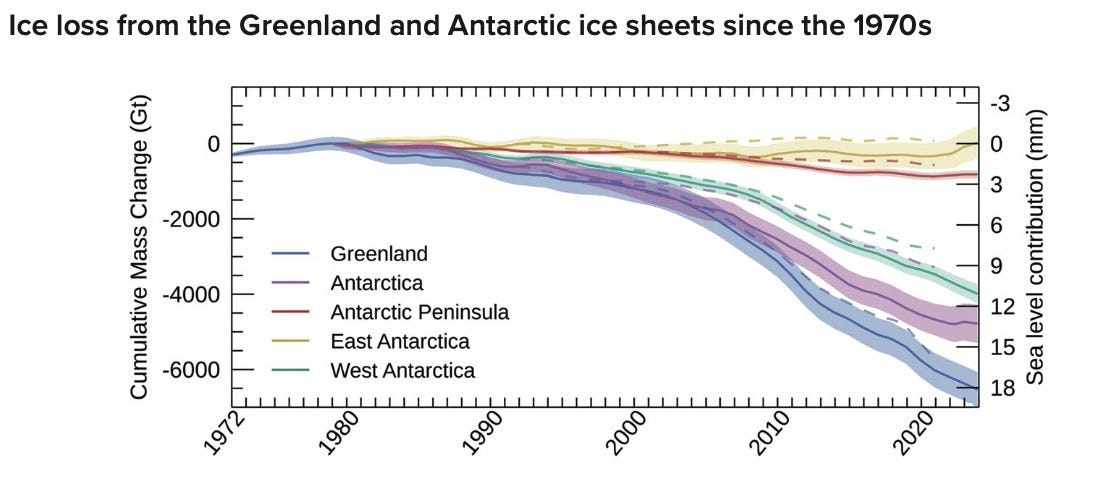
The threat from sea-level rise for coastal communities is not just a few feet of movement on the high tide mark. Storm surges on top of baseline rise make coastal flooding worse, reaching further inland and causing more damage. Salt water intrusion creeps inland affecting freshwater lenses disrupting crop irrigation and human water supplies. In Bangladesh, salt water intrusion and river erosion already extends tens of kilometres inland forcing subsistence farmers to abandon their homes at a rate of 50,000–200,000 a year. The threat to SIDS is existential.
By 2050 large areas of the Nile Valley, Bangladesh, Indonesia, Vietnam, and parts of Florida and Louisiana could be uninhabitable due to a combination of storm flood damage and salt water ingress. This affects food security as well as habitat, as many low-lying regions are important global crop regions. Using Bangladesh as an example, by 2050, one in every seven people will be displaced by climate change, meaning up to 18 million people may have to migrate.
Storms that make landfall near coastal communities will likely bring more extensive flooding. This will increasingly affect many global cities with large populations as well as more remote regions.
Future B
Stabilisation. Every climate scenario commits the world to roughly 20 centimetres of sea-level rise by 2050 compared with the turn of the century, so the question for the coast is what to do with water that’s already on its way. Three ideas get serious money. One is the seabed curtain proposed for Thwaites, a flexible barrier anchored to the Antarctic seafloor that would keep warm deep water away from the base of the glacier, slowing its melt rate. Its designers estimate $40 to 80 billion to build and $1 to 2 billion a year to maintain. If it works, it’s one of the most direct things anyone could do to hold back the West Antarctic Ice Sheet. Construction has started by 2050, but most of its payoff comes after 2100. The second is research funded by the Arête Glacier Initiative into whether a glacier like Thwaites could be slowed, either by refreezing its bed with long heat pipes called thermosiphons or by pumping out the meltwater it slides on. It’s lab and modelling work at an even earlier stage, and by its own account Arête doesn’t yet know enough to design anything. The third is putting some of that water somewhere else, into the desert basins and shrinking inland seas that sit below sea level, like the Qattara Depression in Egypt, the Dead Sea, and the Caspian. The Coastal Futures Resilience Initiative has looked at eleven candidate basins. What they can hold is small next to the ocean, and the bigger estimates depend on what happens to the water that evaporates from them. None of this lowers sea-level much by 2050.
Adaptation. Singapore’s new coastal protection code requires coastal developments either to build protection for 2.15 m of sea-level rise now, or to build for 0.7 m first, with foundations that can take them up to 2.15 m later. Singapore’s then prime minister guessed in 2019 that protecting its coast could cost S$100 billion or more over a century. In Future B every exposed coastline follows the Singapore model. The Netherlands already spends about €11 billion a year on water and flood protection, and its Delta Commissioner says that has to double. Bangladesh’s own Delta Plan calls for about 2.5 per cent of GDP a year, roughly three times what it spends now. UNEP estimates developing countries will need around $305 billion a year by 2035 for all adaptation, not just coasts, and international public finance covers about a tenth of that today. In Future B the gap gets closed. Delta countries also keep salt water out of fields and freshwater supplies, and plan managed retreat for the places that can’t be defended, the way Fiji has already moved several villages. Sea level in 2050 is no lower, but a storm surge reaches fewer homes and water supplies.
Start by: now, since the curtain, inland storage, and Singapore-scale defences all take decades.
SAI decision point: for 2050 it has already passed. Cooling the atmosphere won’t pull the extra heat back out of the ocean, and SAI would only slowly change the sea-level rise already locked in for the centuries after.
A northern European winter
The subpolar gyre (SPG) is a large anticlockwise surface circulation of waters in the North Atlantic. It is a major part of the wider Atlantic Meridional Overturning Circulation or AMOC, playing a key role in drawing warm surface waters northwards. This circulation gives northern Europe its temperate climate, especially during the winter months. This means that the SPG is important to determining the strength of the overall AMOC and its likely tipping behaviour. The heat movement also affects the path and flow of the polar jet stream, an atmospheric current of air moving west to east. So altogether, the SPG plays an important role in determining the weather patterns over the British Isles, northern mainland Europe, and Scandinavia.
Future A
In this scenario we envisage GMST to have reached the peak of 1.8°C which has triggered the tipping point for the subpolar gyre system in the North Atlantic. This is based on the assessment of the Institute for Public Policy Research (IPPR) and the Strategic Climate Risks Initiative in the UK. The report finds evidence that suggests up to a 45% chance of the SPG collapsing this century and happening as early as 2040, if not before. Once triggered, full collapse is complete after just 10 years.
The key climatic changes expected by 2050 in this scenario would be:
Colder winter conditions with extreme freezing events that are 5 times more likely than today.
More extreme winter storms bringing disruption to critical infrastructure including energy and transportation.
More prolonged summer heatwaves and droughts than even the warming alone anticipates.
Reduction in crop growing season length.
Increased risk of overall AMOC collapse by the end of the century.
Future B
Stabilisation. Without SAI, the biggest idea left is adding salt to the North Atlantic so surface water gets dense enough to sink again. At the Global Risk and Stabilization Summit in Reykjavík in October, I (Paul) took part in a scenario exercise about a gyre collapse in 2031, and when it came to prevention, all my table had was a rapid deployment of SAI. That got me curious about salt, which I wrote about in Thinking Bigger About Stabilization. It sounds crazy at first, but just offsetting the extra fresh water from Greenland’s melting would take something like 9 to 10 billion tonnes of salt a year, roughly 35 times what the whole world produces, but also about the same weight as all the coal humanity digs up in a year, so humans could potentially do that. A research project at the University of Chicago is working out how much salt it would take to restart the circulation after a collapse, whether smaller, earlier doses could prevent one, and how you’d spread that much salt. We’d also need to know what it would do to ocean life. Slowing Greenland’s melt would also help, though how much is very contested. All of this gets research money, and by 2050 there have been small trials at sea, but it’s hard to see any of it working at a scale that changes whether the gyre tips by then, or the risk of the whole AMOC collapsing later in the century.
Adaptation. Iceland took the risk of an AMOC collapse to its National Security Council in 2025, and in Future B every government in northern Europe plans that way. By 2050 grids and energy storage are built for much colder winters and hotter summers, a lot of the housing has been insulated, water mains and sewers have been relaid deeper so they don’t freeze, farming has adjusted to shorter growing seasons and longer droughts, and there are emergency plans for winter storms that knock out power and transport. The winters are just as harsh, but far fewer people are hurt by them.
Start by: now, for the research and for the slow parts of adaptation, since insulating a country’s housing and infrastructure takes decades.
SAI decision point: before the gyre tips. If the IPPR is right that it could tip as early as 2040, a decision that mattered would have to be made in the 2030s. In a 2024 modelling study, aerosols switched on in 2080 cooled the surface within a few years but didn’t restart the North Atlantic’s deep sinking before the run ended in 2100. So SAI isn’t a late rescue for the ocean, though the same study suggests that starting early could help.
A hot country in a strong El Niño
The ENSO cycle regulates rainfall around the planet to an extraordinary extent. The most devastating time of the cycle is the El Niño where eastern Pacific Ocean temperatures increase. This brings flooding to some areas, such as East Africa, and drought to others. From a food security perspective, El Niños can be highly damaging. We have selected Central America as the focus here, but similar effects are felt elsewhere in the world, affecting hundreds of millions in the Global South with food insecurity and hunger, and equal numbers in the Global North with food price increases and cost of living crises.
The dry corridor of Guatemala, Honduras, El Salvador, and Nicaragua is particularly susceptible to El Niño-driven drought which leads to failed crops and humanitarian crises. In this scenario we imply a strong El Niño event developing in the summer of 2049 which peaks in December 2049, with the weather and food security implications stretching into 2050.
Future A
By 2050, the GMST will already be about 1.8°C, the peak of the overshoot. This is still considerably better than the more than 2.5°C that would have been the case without the rapid emissions cuts now proposed. We assume that global food and humanitarian aid levels have not changed radically from the 2026 levels. Even so, the world has over 2 billion people in food insecurity, over 600 million in chronic hunger leading to malnutrition and health issues, and over 250 million in acute hunger, at risk of famine conditions. These will be the baseline values ahead of the strong El Niño developing through 2049.
The dry corridor is on the front line of an El Niño. The rains fail quickly and, through unfortunate timing, the first crop of the year coincides with the now dry earth. As the 2049 El Niño develops, the first crop fails. A second window of opportunity opens with the second planting in September, but this goes into dry hard soil. By November it is clear that this second crop has also failed and states of emergency and calls for aid are issued. Food is urgently needed, not just for the rest of the year, but most of the way through 2050 as reserves run out.
Food exporting countries are also struggling. Two of the world’s wheat bread baskets have seen yields drop by over 20% due to heat waves during the grain filling season. Rice too is in short supply following floods in Vietnam and monsoon failures in India. India declares an export ban to support its own population. The UN declares a famine in Honduras. The West is slow to respond as governments try to deal with riots in Paris, London, and Madrid over cost-of-living increases as food inflation tops 12%.
Future B
Stabilisation. There isn’t much stabilisation can do for a drought in Central America without cooling the whole planet. By 2050 a lot more of the hillsides in and around the dry corridor have been replanted. Across most of the tropics, air that has passed over a lot of vegetation in the previous few days produces at least twice as much rain as air that has passed over very little. Small check dams and levees that slow runoff keep more water in the soil, though nobody has shown they bring the rain back.
Some researchers think forests matter even more than that. The biotic pump hypothesis, first proposed by Anastassia Makarieva and Victor Gorshkov in 2007, holds that large forests actively pull moist air in from the ocean, which would make restoring forests upwind of places like the dry corridor a much bigger lever on rainfall than standard climate models assume. It’s still debated, and mainstream atmospheric science remains sceptical, but if it holds up, forest restoration belongs near the top of the Future B list.
Adaptation. In Future B the world acts as soon as the El Niño forecast comes in. A small version of that happened in April 2026, when UN agencies used money set aside in advance, including $10.5 million from the UN’s emergency fund aimed at about 145,000 people, to get cash, food, and water kits to farming families in the dry corridor before the rains failed. About 3.5 million people there needed help during the 2014–16 El Niño, and by 2050 the pre-arranged money is something like ten times what was set aside in 2026. When the first crop fails, families already have cash, seed for drought-tolerant beans and maize, and water stored for the second planting. Central American agriculture ministers agreed in 2024 to create a regional grain reserve, and by 2050 it’s full before the drought starts. The heat still cuts wheat and rice harvests elsewhere, so food prices still rise, but the big food exporters have agreed in advance to limit export bans during a crisis. That would be new, since the only firm commitment today is a 2022 WTO decision that protects food bought by the World Food Programme.
The rain still fails, and the crops in the dry corridor fail with it. But help arrives before families run out of food, so far fewer people go hungry. As Tom and Mark Roberts wrote, “Physics sets the shock. Policy sets how many people go hungry.” And as warming climbs, preparation like this does less and less.
Start by: before the next strong El Niño. The current event is a test of how much of this is already in place, and how much more is required.
SAI decision point: no deadline. SAI could ease the heat, though its effect on crops is still debated. A 2018 study used past volcanic eruptions to estimate that the dimmer sunlight would roughly cancel out the crop benefit of the cooling, but a 2021 modelling study found the dimming mattered much less.
The five domains side by side
The cost of deciding against SAI
Future B’s stabilisation does the most for a reef or a stretch of sea ice, where the damage is in one place and you can aim something at it. For the heat in Central America and the gyre in the North Atlantic, which follow the global temperature, it does very little, and it’s up to adaptation to limit the damage. We think that’s where deciding against SAI costs the most people. The window for SAI has already passed for most reefs and for the coast by 2050, it closes in the 2030s for the gyre, but it remains open for the heat.
SAI could lower the peak, cut the odds of the gyre tipping, and take the edge off the heat in places like the dry corridor. But it wouldn’t stop the sea-level rise that’s already locked in or bring back the reefs we’ve lost. It would also come with its own risks and questions, like what it does to regional rainfall and how fast you can safely cool an ocean that has been soaking up heat for decades.
A lot of the debate about SAI weighs its risks against a world without it, as if that world were safe, and the five domains above suggest it wouldn’t be. Many have argued for years that the risks of cooling the planet are smaller than the risks of not cooling it. Future B is the absolute best our world can do without SAI, and the risks it can’t help are the ones driven by global heat.
We don’t know with enough confidence today that SAI is safe to deploy. But we can say with enough confidence that it’s too hot and that we need to find ways to bring the temperature down. If the world decides against SAI, it has to find another path, and that path is far narrower than most people assume. So all of the work in Future B is needed whether or not the world ever decides to use SAI.
What to do now
The overshoot clock has already started, and almost every start-by date in this piece says now. The reef work, the seabed curtain, inland storage, sea ice thickening, and the grazing experiments in Alaska all need years of research and testing before anyone could use them at scale. The adaptation in Future B already exists in pieces and needs to be copied much more widely. And the research on SAI needs to keep going, so that if governments ever do face that decision, they can make it with real evidence.
We also need to remember that Future A is the Highest Possible Ambition emissions reduction pathway and is by no means a default. Future B adds to that massive endeavour with even more effort and financial requirements. Both are therefore very best case scenarios. Unless we follow them immediately and with full commitment, the reality will be much worse.
Further reading
United Nations Environment Programme (2026). Limiting Overshoot: Navigating exceedance of 1.5°C and pathways towards return. https://doi.org/10.59117/20.500.11822/49857
United Nations Environment Programme (2026). Emissions Gap Report 2026: The point of return. https://doi.org/10.59117/20.500.11822/50038
Lenton, T. M. et al. (eds) (2025). The Global Tipping Points Report 2025. https://global-tipping-points.org/
Laybourn, L. et al. (2024). The security blind spot: Cascading climate impacts and tipping points threaten national security. IPPR. http://www.ippr.org/articles/security-blind-spot
Climate Crisis Advisory Group (2026). Stabilising Earth’s Systems. https://www.ccag.earth/reports/stabilising-earths-systems
United Nations Environment Programme (2026). Adaptation Gap Report 2026: Ready? Not. https://www.unep.org/en/publications/report/adaptation-gap-report-2026
James Hansen has been warning us for years that the IPCC is basically pushing hopium on us. We'll be so high on totally pie in the sky scenarios that we'll boil like lobsters in the pot as Earth heats up. Future A is a hopium induced pipedream
Welcome to the pipemare. As Earth burns..
Very informative and convincing. A few points: (1) I was surprised there was no discussion of heat waves and excess deaths. It Europe had 50K heat wave deaths in 2026 and countries across southern Asia had likely similar, and peak heat waves now are over 40 C with often high humidity, the need for air conditioning and the power for it (plus suitable buildings) will be huge, and likely lead to both deaths and huge emigration pressures from low latitudes. (2) On Arctic warming, is not the amount of air temperature rise greatest in the fall and spring as the warm season gets longer--this certainly causes the consequences you mention. Do you think the collapse of AMOC will have a cooling effect on the Arctic by leading to greater sea ice formation and even a chilling of permafrost that carries over into the summer season as it takes time for heat to get conducted downward? (3) I continue to be discouraged by the continuing emphasis on the risks of SAI with very little supporting documentation. Volcanic eruptions that have created quite significant hazes in the stratosphere and there seems to be very little mention of adverse effects due to the climate cooling until one gets to really large eruptions--and planned intervention levels would be way below peak amounts and the studies injecting into the stratosphere in various latitudes and seasons show potential for optimizing in ways to potentially avoid serious outcomes. Yes, there will not be a perfect return, but should not the question be if one gets back to within the range of variability to which societal systems have proven resilient or could do so through relatively limited adjustments through the economic system? In my view, too much of the evaluation of the SAI simulations is about relatively small departures from the preindustrial mean. I would think that some deeper looking at SAI consequences and benefits would be helpful.